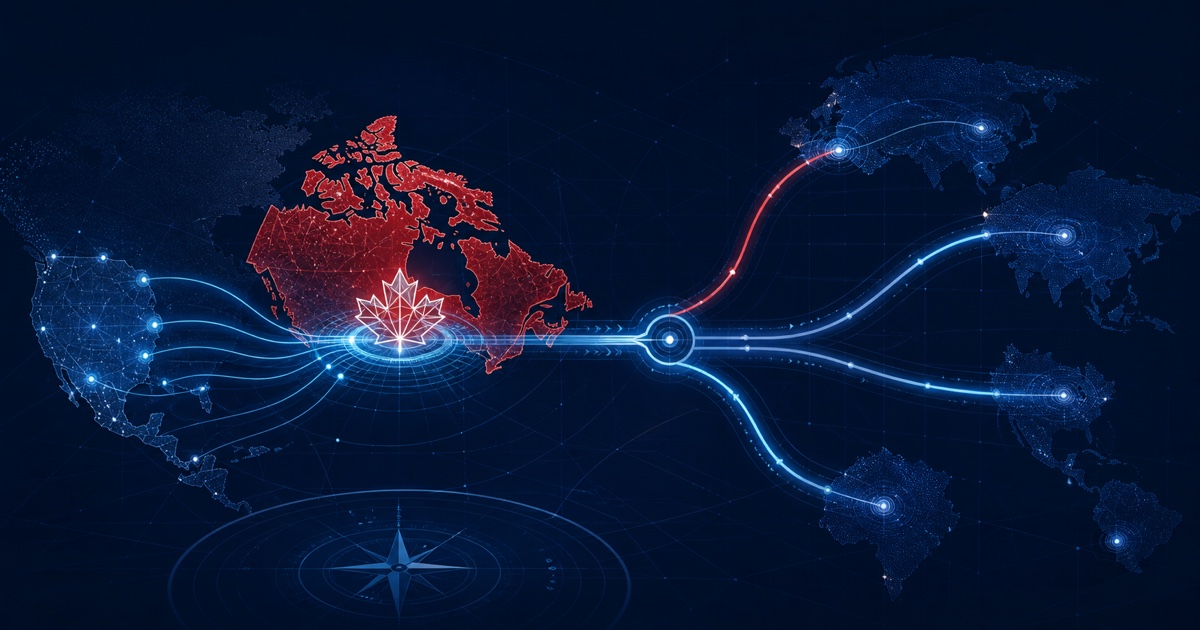
On 21 August 2026, Prime Minister Mark Carney announced that Canada had suspended its current trade negotiations with the United States. The government said last-minute U.S. terms were “unfair, uneconomic,” and raised questions about reliability. It also announced that Canada would match a proposed 50% U.S. tariff on roughly $28 billion of Canadian goods, dollar for dollar.
The immediate story is about tariffs. The deeper story is about strategic choice.
Canada’s decision should not be read as a rejection of trade, the United States or economic interdependence. It is better understood as a refusal to confuse access with control. It is also an attempt to preserve the ability to choose when the terms of a critical relationship change.
The choice was not trade or sovereignty
Canada and the United States remain deeply connected. Supply chains, energy systems, investment, security and communities cross the border every day. The Government of Canada’s Spring Economic Update says the Canada–United States–Mexico Agreement continues to keep approximately 85% of Canadian exports to the United States tariff-free. That access matters enormously and should be protected.
But interdependence does not remove the need for agency. It makes agency more important.
A country does not become sovereign by eliminating every external dependency. That would be neither practical nor desirable. It becomes more operationally sovereign when it understands which dependencies are critical, knows what outcomes must be protected and can still act when cooperation is withdrawn or made conditional.
This is the distinction at the heart of OSAF. Sovereignty is not a label attached to geography, ownership or policy rhetoric. It is a capability that must survive contact with a real scenario.
The strategic question is not whether Canada depends on the United States. It is what Canada can still decide, protect and change when that dependency is used as leverage.
Rights that cannot be exercised are weak controls
Trade agreements, negotiated commitments and lawful countermeasures create important rights. Yet a right on paper is not the same as a right that can be exercised under pressure.
The same principle appears in technology. A contract may promise data portability, recovery or termination assistance. Unless the organization has the evidence, people, resources and tested path to use those rights, the practical control may be far weaker than the formal wording suggests.
For Canada, leveraging its rights means more than citing an agreement or announcing a tariff. It means having the institutional capacity to document the case, sustain countermeasures, support affected workers and businesses, coordinate across governments and industries, and develop credible alternatives over time. A negotiating position becomes leverage only when the other party believes Canada can carry it.
OSAF lens
- Critical dependency
- Access to the U.S. market and integrated continental supply chains
- Trigger
- New tariffs and late-stage terms that Canada judged unacceptable
- Outcome to protect
- Economic stability, employment and strategic-industry resilience
- Capabilities
- Decide & Govern · Substitute & Exit · Maintain & Adapt · Assure & Verify
If market access changes, what can Canada still do?
What leverage actually requires
Strategic autonomy is easy to declare and difficult to operate. Five elements turn a statement of independence into usable negotiating capacity.
- Evidence.Canada needs defensible data on trade flows, sector exposure, compliance, economic consequences and the effects of proposed measures. Evidence converts a political position into a case that can be negotiated, challenged and evaluated.
- Capacity.Workers and firms bear the near-term cost of economic pressure. Fiscal, industrial and institutional support makes it possible to hold a position long enough for it to be credible.
- Options.Market diversification, infrastructure and new trade relationships do not replace the United States. They reduce the risk that one relationship becomes the only viable route to an outcome.
- Coordination.Federal, provincial and territorial governments, industry and labour need a shared view of priorities and trade-offs. Fragmented decision-making turns domestic dependencies into external leverage.
- Time discipline.A deadline can focus negotiations, but it can also manufacture consent. The ability to pause is a control when the alternative is accepting terms that undermine the outcome being protected.
Why this is the right strategic posture for Canada
The suspension is defensible not because confrontation is desirable, but because a relationship as valuable as Canada–U.S. trade needs reliable terms. “A deal at any price” would not preserve the relationship; it could embed uncertainty and weaken Canada’s ability to govern future choices.
The right objective is not maximum autonomy. OSAF explicitly rejects that reflex. The appropriate level of autonomy depends on the consequence. In this case, the consequences reach strategic industries, employment, investment and the public policy choices of future governments. That calls for a higher standard of demonstrated control.
Canada should therefore keep the door open to negotiation while making clear that continued access cannot require surrendering the capacity to decide. It should use the rights available under existing trade arrangements, apply proportionate countermeasures, protect those carrying the adjustment cost and accelerate credible alternatives. Negotiation and resilience are not competing strategies; resilience improves the quality of negotiation.
There is also an important discipline here: the government’s forecasts and investment figures are claims that should be tested against outcomes. An evidence-led sovereignty strategy must measure whether support reaches exposed firms, whether diversification produces durable market access and whether new infrastructure actually reduces critical dependency. Announcing capacity is not the same as demonstrating it.
Sovereignty is the capacity to choose and carry the choice
Prime Minister Carney’s statement presents a clear strategic choice: accept terms the government believes are unfair and unreliable, or absorb near-term pressure in order to preserve longer-term agency. Suspending the negotiations asserts the choice. Canada’s ability to sustain workers, businesses, institutions and alternatives will determine whether that choice is operational.
This is why the moment connects so directly to the sovereignty discussion behind OSAF. A sovereign posture is not proven when conditions are normal. It is proven when a critical dependency changes and the actor can still continue, control, recover, adapt or exit in defence of a defined outcome.
Canada should seek a stable and mutually beneficial agreement with the United States. It should also be prepared to say no when the terms compromise the very capacity that makes meaningful agreement possible. That is not withdrawal. It is sovereignty made operational.
Sources and further reading
- Prime Minister’s Office: Statement on Canada–U.S. trade negotiations, 21 August 2026 ↗
- Prime Minister’s Office: Statement on ongoing negotiations, 18 August 2026 ↗
- Government of Canada: Spring Economic Update 2026, Chapter 1 ↗
- Department of Finance Canada: Canada’s response to U.S. tariffs ↗
- Global Affairs Canada: Canada–U.S. engagement ↗
This independent article applies the Operational Sovereignty Assessment Framework to a public-policy decision. It reflects the author’s research perspective and is not legal, investment or economic advice, nor an endorsement by the Government of Canada.